

The looks get the attention, but one engineering choice is what’s dividing audiophiles.
Much of the audio industry is focused on wireless features, AI tools, and faster refresh cycles. Meze Audio is moving in a different direction with a pricey wired headphone built for listeners who still want a dedicated high-end setup.
Called the ARTA, the new model packs what Meze describes as the world’s highest-impedance planar magnetic driver. It also looks more like a sculptural art piece than conventional audio gear, giving the $6,000 flagship a visual identity as ambitious as its engineering.
Meze’s New ARTA Is Built Like a Luxury Object
At $6,000, the ARTA sits above both the ELITE ($4,000) and Empyrean II ($2,999) in Meze’s lineup. It made its first public appearance at High End Vienna 2026, where it introduced a new flagship tier rather than replacing either existing model.
Rather than following the familiar shape of many high-end headphones, the ARTA leans into a more sculptural identity. Meze describes the design as a blend of futuristic, bionic fluidity and Art Nouveau-inspired styling.
The result is a headphone that resembles a piece of industrial sculpture as much as a listening device.
Visually, that luxury treatment is backed by a mix of precision-machined metal, carbon fiber, and leather. Like Meze’s other upper-tier products, each pair is hand-assembled in Baia Mare, Romania.
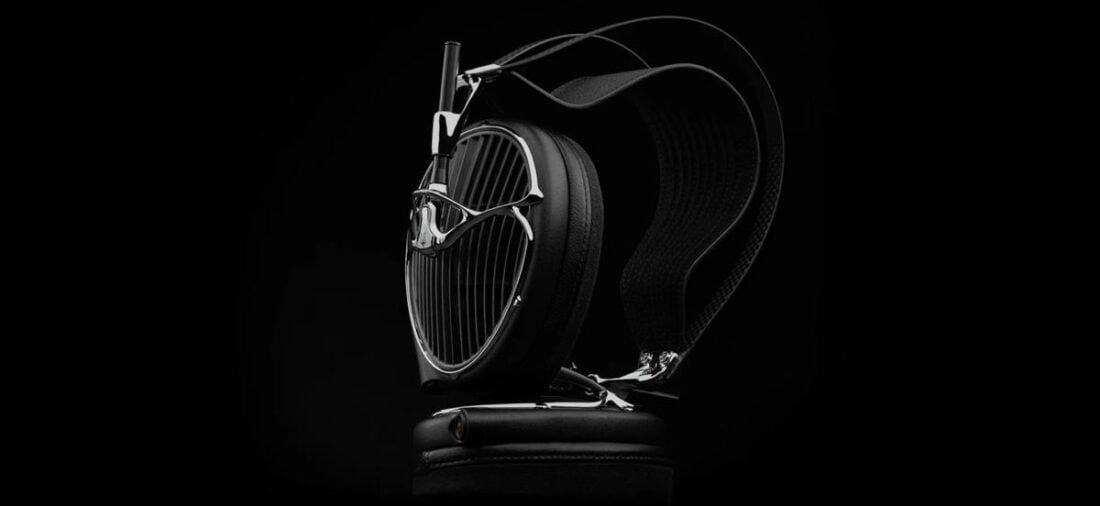
Construction is also where the ARTA’s design story moves beyond appearance. Meze says every major component can be serviced or replaced, which gives the headphones a different kind of luxury appeal built around premium materials and long-term upkeep.
That approach separates the ARTA from many consumer electronics products that are often discarded once a single part fails or a newer model arrives. At this price, serviceability becomes part of the value argument rather than a small afterthought.
The ARTA is still clearly designed as a statement piece. Its more interesting pitch, though, is that its luxury appeal depends as much on how it can be maintained as how it looks.
The World’s Highest-Impedance Planar Driver
Inside the ARTA is a new driver developed with Rinaro Isodynamics. Known as the Rinaro High Impedance Isodynamic Hybrid Array MZ5 HΩ, it is being billed as the highest-impedance planar magnetic headphone driver ever created.
The driver operates at an average impedance of 225 ohms. By comparison, both the ELITE and Empyrean II use 32-ohm designs.
Such a high impedance makes the ARTA less suited to phones, dongles, and entry-level portable setups. Instead, it points the headphones toward listeners who already use dedicated headphone amplifiers and high-end source equipment.
Meze frames that limitation as part of the design goal. According to the company, the high-voltage, low-current approach is intended to improve linearity, stability, and signal purity, trading convenience for a more controlled performance ceiling.
The surrounding acoustic design is meant to support the same goal. One of the most visible elements is a grille made from angled acoustic blades, which helps reduce internal reflections for cleaner transients and a more open presentation.
On paper, the specifications reflect the company’s ambitions. Meze claims a frequency response of 3 Hz to 115 kHz and total harmonic distortion below 0.05%.
Comfort is another consideration at this level. At 495 grams, the ARTA is heavier than both the ELITE and Empyrean II.
Even so, Meze has built a strong reputation for comfort. The company also appears confident that the weight distribution will remain suitable for long listening sessions.
Meze Wants Headphones to Sound More Like Speakers in a Room

The ARTA was created with a specific goal in mind: making headphone listening feel less like wearing headphones.
That goal extends beyond tonal balance. It also influences how the headphones present space and instrument placement.
Meze describes the tuning as warm-neutral. Additionally, the company says the soundstage is designed to recreate the spaciousness of listening to speakers in a well-treated room.
The combination of its new driver and open acoustic design creates a more natural sense of space and positioning.
Speaking with TechRadar at High End Vienna, Grigoras also noted that the ARTA is more open than other headphones in Meze’s lineup. He credited its thin, lightweight diaphragm for helping create that effect.
Early listening impressions have been encouraging. After trying the ARTA at the show, TechRadar reported exceptionally clear vocals, strong tonal accuracy, punchy bass, and precise instrument placement.
Still, those impressions came from a brief demonstration in a show environment. Independent reviews and long-term listening tests will ultimately determine whether the ARTA delivers on Meze’s ambitious claims.
Audiophiles Are Already Debating the Price
The ARTA’s price has already become one of its biggest talking points. In a market where flagship headphones regularly push into luxury territory, Meze’s new model still lands high enough to invite scrutiny.
On Head-Fi, some users questioned whether any headphone can justify a $6,000 price tag. One member went as far as to describe the ARTA as a Veblen product. Others defended the launch, arguing that Meze has earned more goodwill than many competitors because it rarely releases new flagships.
Those reactions highlight the challenge facing the ARTA. Premium materials, unusual engineering, and serviceable construction can strengthen the value argument, but none of those will matter much if the sound does not meet expectations.
Price also changes how the headphones will be judged. At this level, listeners are not only comparing the ARTA against Meze’s own ELITE and Empyrean II. They are also weighing it against other summit-fi headphones, dedicated desktop systems, and the kind of speaker-like presentation Meze says it is trying to achieve.
Ultimately, the ARTA is Meze’s most aggressive statement yet.
Its high-impedance planar driver gives it a clear technical hook, while its luxury build gives it a clear visual identity. Independent reviews will decide whether those strengths are enough to justify its place in the $6,000 tier.