

They offer a “premium fix” for the noise they admit exists, so we broke down every detail to see what’s real.
High-frequency noise from WiFi, LED lights, and digital gear exists in every modern home. One cable manufacturer now claims this noise rides along signal grounds and sells thousand-dollar devices to pull it out of your system.
However, the company provides no measurements or listening tests to show how the devices actually work.
The Rare Admission
Most cable manufacturers avoid discussing technical problems that might give doubt to their premium pricing. But Alan Gibb, the Managing Director of Chord Company, is unusually candid as he admits hi-fi cables transmit high-frequency noise.
“If high-frequency noise were entering a hi-fi system, all our cables would be shunting it around the entire system with minimal attenuation,” Gibb told HiFi Plus.
That noise comes from LED lights, WiFi routers, mobile phones, and the digital circuits filling modern homes. It travels through signal grounds connecting your components.
This admission matters because Gibb runs a company selling cables that cost hundreds of pounds. Chord’s Sarum Tuned ARAY speaker cables, for example, start at £1,650 for a 1.5-meter pair.
“If you get high-frequency noise on the clock circuit ground in your CD player or DAC, jitter goes up,” he explained.
“It’s like driving a Ferrari over a ploughed field.”
So how does Chord solve this problem? The brand promotes its proprietary ARAY and Tuned ARAY conductor geometries as ways to control high-frequency noise, and its GroundARAY devices as parallel ground paths that drain interference away from audio circuits.
In Gibb’s description in HiFi Plus, these devices use “military-grade materials” and convert unwanted noise into heat by creating an electrical potential gradient.
But those claims only matter if they are backed by evidence. And in Chord’s public materials, that evidence is missing.
The Missing Measurements

The company has published none of the standard tests engineers would use to verify noise-reduction technology, such as:
- Before-and-after noise floor data with GroundARAY or ARAY in and out of the system
- Frequency response or RF-rejection measurements showing noise converted to heat
- Jitter measurements on DAC or CD player clock circuits, despite explicit jitter claims
- Controlled or blind listening tests comparing Chord products to ordinary cables
Beyond Chord’s own descriptions, there are no published reports from independent labs and no third-party verification. Basically, the interview contains technical-sounding language but no quantifiable data.
A former chief electrical engineer at Bell Communications Research notes that it’s a common pattern among audiophile cable manufacturers.
Wire behavior is among the most well-understood areas of electrical engineering. Yet manufacturers discuss “qualitative issues” while rarely providing “hard numbers.”
“Of all the things scientists and engineers understand about electricity, wire has to be at or near the top of the list,” the Bell engineer said.
“The success of the audiophile wire industry is based entirely on the utter ignorance of the market. The whole thing is based on hope and fear among potential customers.”
Without all these, everything remains marketing speak.
Another example is the claim for “military-grade materials” that carries similar issues. What materials specifically? What makes them military-grade? What are their electrical properties at various frequencies? The term suggests ruggedness without providing technical information.
What Blind Tests Show
Gibb’s RF claims also sit inside a bigger pattern in the audiophile cable market. Even when RF isn’t mentioned at all, expensive cables almost never show a clear advantage in blind tests.
This pattern holds across decades of testing:
One of the most famous examples comes from SoundGuys, who compared steel coat hangers to premium oxygen-free copper cables in a controlled test. They measured frequency response deviations “mostly under 1 dB,” with only a narrow 10 kHz peak that might be audible in theory.
But, they concluded those differences “will absolutely get lost in music.”
In the blind polling, 41.7% of listeners said both cables sounded equal, 32.4% preferred the expensive cable, and 29.5% actually preferred the coat hanger.
The same thing happens when you look at community and club tests.
For instance, a long-running Head-Fi thread collected blind comparisons between $2.50 blister-pack wire and $990 speaker cables. Across trials, picks were scattered roughly 50/50 between cheap and expensive.

The RF Reality Check
If premium cables can’t reliably beat coat hangers in blind tests, RF-based marketing deserves even closer scrutiny. So the next question is whether RF interference actually creates audible problems in home audio systems, or whether measurements tell a different story.
Brent Butterworth challenged this assumption when he investigated claims that open RCA inputs act as RF antennas, creating “white noise.” Testing a Parasound Halo P 5 preamp, he found the negative 3 dB point at about 100 kHz. RF signals, by contrast, operate in the megahertz range, far above this cutoff.
The preamp’s design explains why. Its input circuitry attenuates signals above 100 kHz, while audio lives between 20 Hz and 20 kHz.
As Butterworth put it, the preamp “ignores these frequencies… just as it ignores the beam of a flashlight.”
He also ran spectrum measurements under three conditions:
- open inputs
- terminated inputs
- a strong TV antenna deliberately connected to create a worst-case RF scenario.
The noise floors came out “practically identical” in all three cases.
Even a strong RF antenna reception produces only negative 30 dBm. That’s one millionth of a watt, and audio signals operate at vastly higher power levels.
So in a circuit built to reject out-of-band energy, that RF power simply does not dominate.
Not to mention, modern audio components are also designed to prevent RF conversion in the first place. Input stages reject signals outside the audio bandwidth. Shielding blocks external interference. Proper grounding eliminates loops that might let noise currents into signal paths.
What it takes for RF noise to matter
On Audio Science Review, contributor and technical expert DonH56 lays out what has to happen before RF pickup becomes audible.
Cables can behave like antennas, but pickup alone does not make RF audible. For it to turn into hiss or hash in the speakers, something in the chain has to demodulate those high-frequency signals down into the audio band through mixing, rectification, or other nonlinear behavior.
Competently designed preamps and DACs are laid out and biased to avoid those nonlinearities in their input stages.
Real systems in RF-heavy locations also show the same pattern.
For instance, ASR member RayDunzl lives about three miles from a major transmitter farm with a 1,400-foot broadcast tower, in a home full of WiFi, cell phones, LED lighting, and digital gear.
Some of his interconnects are nothing more than unshielded magnet wire. But, he still reports that his system is “dead silent” with “no audible nor measurable defect.”
What Actually Works
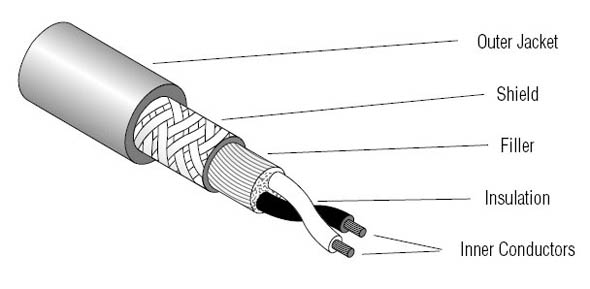
When RF noise does crop out, working engineers reach for simple tools, not £550 accessories.
Here are a few tips:
- Use balanced cables and twisted-pair lines. Professional audio standards established decades ago recommend balanced connections wherever possible. Twisted-pair construction gives much greater immunity to magnetic field interference because both conductors pick up the same noise, which cancels when the differential signal is recovered.
- Bond shields to chassis, not signal ground. Shields should connect to chassis ground at the point of entry instead of to signal ground. This keeps noisy shield currents off the audio return path and prevents ground loops from dumping interference into sensitive circuits.
- Add ferrite beads near RF sources. Proper shield grounding matters more than cable price. Adding a ferrite bead over a cable with a properly grounded shield can reduce chassis current from hundreds of milliamps to roughly 20 milliamps, which is about 35 dB of noise reduction. Ferrite beads cost less than a pound.
- Terminate unused inputs. When you are worried about open inputs acting as antennas, simple RCA terminators keep them from picking up interference. Generic caps cost about $1, and companies like Cardas sell nicer versions for around $5.
None of these fixes require proprietary £550 boxes. For most home systems, the evidence points to balanced lines, sensible grounding, and the occasional ferrite bead as all you need to keep RF under control. That way, you can keep your upgrade budget focused on changes that actually affect what you hear.
Covering, filtering, and shielding ignore free-oscillating waves of any frequency.
I’d be more concerned about the blown out woofer surrounds in the photo you posted over noisy cables.
All cables spread all noise everywhere. They aren’t selective, that’s the job of a well designed interface, output and input filters, grounding and circuit PSRR. Who writes this junk.
Military Grade = lowest bidder
Excellent explanations and advice.
Do not expect advertising income from cable and filter vendors.
Marketing fluff. I have a Chord coax cable for my Dac. The promises made on the box were Incredible. Do I hear those claims, no. Same sound as before. I was not expecting a change, I purchased the cable because it was on offer and my old cable did go faulty.