

Everything measured fine, but one player sounded wrong every time.
A veteran audio engineer who spent two decades convinced that all well-measuring DACs sound the same just had that belief shattered.
After trying two high-end CD players and a cheaper rack-mount unit, he started hearing differences he couldn’t ignore. Some music sounded harsh and tiring on one player but smoother and more detailed on another.
What followed was one of the most detailed, community-driven investigations into CD player sound in recent memory.
How the Test Was Conducted
To figure out why one CD player made music sound harsh and tiring, tcpip ran listening tests using gear he trusted to be clean and neutral. That’s because his goal was to hear what the CD players were doing, not what the amp or headphones were coloring.
For this, he used two headphone amps:
- JDS Labs Atom Amp 2
- RME ADI-2 FS Pro (in preamp mode)
And rotated through a variety of headphones and IEMs, including:
- Moondrop Chu II
- Etymotic ER4PT
- Sennheiser HD 650
- (and others like Truthear Zero:Red and Tanchjim One)
Three CD players were compared during the test:
- Player A – a high-end model released less than a year ago
- Player B – a similarly priced premium unit from two years ago
- Player C – a rack-mount CD player meant for commercial installs, not consumer hi-fi
All three players were tested through their analog outputs, and no external DACs were used in the main tests. He also kept the cables consistent and used the same music tracks for each comparison.

The listening methodology
Instead of doing strict level-matched, blind A/B tests, he focused on casual back-to-back comparisons.
But it wasn’t perfect. Since his equipment had only one analog input, he had to swap cables and discs each time, which is not ideal for quick switching, but enough to notice broad differences.
Plus, to check whether volume was skewing his impressions, he adjusted the gain by more than 2dB up and down while listening.
So, to verify his findings, two other listeners also helped cross-check the results. One was his 18-year-old son, a musician with no interest in audio gear. The other was a fellow engineer who owns an Audio Precision analyzer.
Both were able to describe differences between players, though it’s worth noting the tests weren’t blind and playback levels weren’t matched precisely.
He’s aware of those limitations. But for him, the differences were consistent enough to stick around no matter what adjustments he made, even when turning up the volume on one player to try and match the other’s impact.
What They Heard
When the engineer started comparing the players, he didn’t expect to hear much difference. But once he spent some time listening, the differences started to stand out.
For one, Player A sounded almost too sharp. He described it as having an “etched” or “edgy” quality that made it hard to focus on the music. Even though it seemed clear at first, the sound became fatiguing over time.
Player B, on the other hand, came across as softer, but not in a dull way. The edge was gone, and yet he could still hear all the details, maybe even more than with Player A. It felt easier to stay engaged with the music.
He was surprised by this as he had always assumed that a softer sound would mean less resolution. In this case, it seemed to reveal more texture and nuance instead of less.
Meanwhile, Player C, the rack-mount model, had a smoother tone than Player A, but didn’t match Player B in terms of depth. Drums, for example, sounded flatter and more one-dimensional.
To see if others heard the same thing, he asked his son to try the test using the HD650s. His son picked up the same difference, calling Player B “softer” and saying he liked it more.
The perceived differences persisted through volume adjustments. The engineer’s friend turned up Player B’s volume by up to 6dB to try and eliminate the “softer” character. That still didn’t change that impression, though.
Additional Findings From the Audiophile Community
After noticing unexpected differences between his CD players, the engineer decided to dig deeper. So, he planned to let others test whether the differences he heard could be measured or even heard by others under more controlled conditions.
He recorded the analog output from each player using the same CD and shared those 24/96 FLAC files online. Then, forum users on DIYaudio and Audio Science Review took on the challenge. They looked at the files, ran comparisons, and offered their own measurements.
Here’s what they found:
Level differences
One of the first things forum member MAB noticed was a mismatch in output volume. Player A was louder than Player B by about 1.7dB, which is more than enough to change how something sounds.
Many listeners tend to prefer the louder option, even if everything else is identical.
Another contributor, solderdude, measured and found an overall level difference of more than 1dB between the players. He explained that this kind of mismatch can make one player seem more detailed or “full-bodied,” even if the actual sound quality is the same.
Frequency response differences
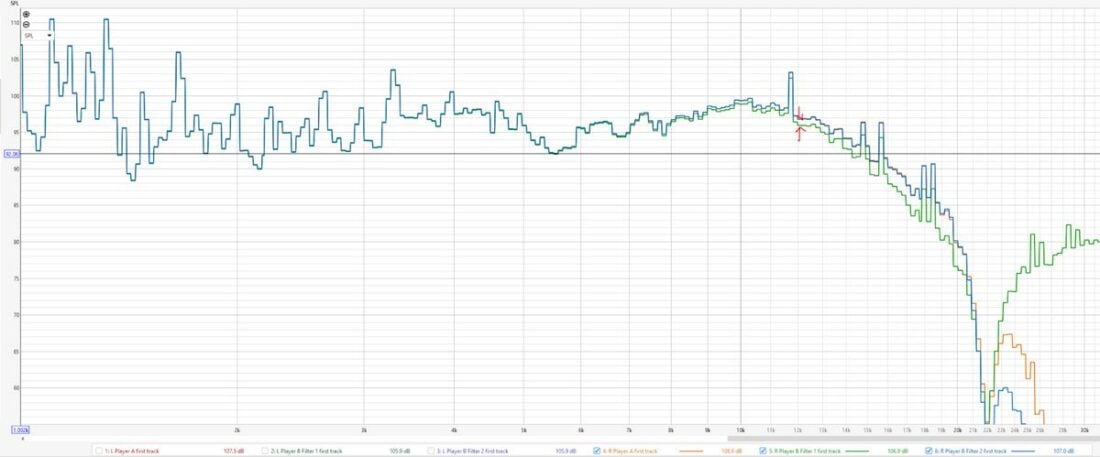
MAB also ran a spectral analysis and found that Player B, when using one of its digital filters, rolled off the treble more than the others. Specifically, it was about 0.5dB lower at 10kHz, 1dB at 12kHz, and 2dB at 16kHz compared to Player A.
These small changes might not be obvious to every listener, but they could affect how sharp or smooth the music feels.
While MAB didn’t label the filter directly, other users like solderdude and EdGr suggested it might be a NOS (no oversampling) filter, which tends to reduce high-frequency energy in exchange for a softer presentation.
Filter behavior
Player B has two filter settings. The engineer didn’t hear much difference between them, but MAB’s analysis showed that Filter 1 had the most rolled-off treble. This might explain why Player B was described as “softer” even at matched volumes.
ABX testing results
Once the files were level-matched, MAB ran informal blind tests using ABX tools. His results dropped to 7 out of 16 and 8 out of 16 correct guesses, which is basically a random chance.
In other words, once volume and filter differences were taken out of the equation, the clear differences he had heard earlier were no longer obvious.
This added weight to the idea that much of what the engineer and others heard may have come down to volume, filter settings, or expectation bias, and not major flaws or differences in the players themselves.
Technical Theories That Explain the Sound Differences
The forum measurements explained a lot, but not everything. So, some users brought up technical factors that might have affected the sound, even if they didn’t show up in the recordings.
Jitter and clock accuracy
One possibility is jitter, which refers to tiny timing errors when digital data is converted into sound.
In a CD player, this can come from the disc motor, especially if the player doesn’t buffer the data well. Several users said that ripped files played through a PC usually avoid this because the data can be corrected before playback.
Others mentioned clock phase noise, which is a more advanced timing issue. If a CD player’s internal clock isn’t stable, it could slightly affect how natural or clean the music sounds, even if the frequency response looks fine.
Analog output design
Even when two players use the same DAC chip, their analog output stages can be very different. Things like op-amp choice, layout, and capacitor quality all shape the final sound that reaches your ears.
Some users suggested this might explain why Player B was more detailed or smoother than the others, especially if one design focused more on clean output than the other.
Power supply and voltage regulation
A few forum members pointed to the power supply, especially the voltage regulators and capacitors. In some gear, cheap or poorly placed components can introduce small noise or instability.
One user said he once found a $1,000 DAC missing basic regulator caps, and fixing that improved the sound. It’s possible that small design decisions like this could create audible differences, even if they’re not always easy to measure.
Time-domain effects
While frequency response differences were already measured, some users suggested that time-domain behavior, like group delay or ringing, might also be involved. These are harder to spot unless you run specific tests, but they can change how transients or fine details come across.
One idea was that Player A’s “edge” might come from small timing distortions, not just louder treble.
Intersample clipping
There was a short discussion about intersample clipping, which happens when the digital signal briefly goes over 0 dB between samples. One person suggested this might explain the harshness in some recordings.
But others pushed back, saying there’s no solid proof that this causes audible problems, especially on modern DACs that handle it properly. In the end, it remained a maybe.
What Audiophiles Can Take Away From This
This whole test started with one big question: Do CD players that measure well actually sound different?
At first, the engineer didn’t think so. But after hearing those differences for himself, and watching others confirm or explain them, he started to reconsider.
The forum tests showed that volume mismatches and filter settings can easily fool your ears. A 1.7dB boost or a rolled-off treble curve can change how something feels, even if the underlying gear is solid.
That alone is a good reminder to match levels and settings carefully before drawing conclusions.
But even after all that, not everything could be explained by numbers. Timing issues, analog stage design, power supply quality don’t always show up on basic measurements. But, they might still shape what you hear.
So what’s the takeaway?
If you’re using revealing headphones or gear, or if you do a lot of listening from physical media like CDs, small differences in players might matter more than you think. You don’t need to chase the most expensive model, but you also shouldn’t assume that all decent players will sound exactly the same.
And if you’re not hearing a difference? That’s fine too. This test doesn’t prove that every CD player sounds different. But it does suggest that sometimes, there’s more going on under the hood than specs can show.
Everything, but CD player name and model number. WHY ??
Pointless
Biamp Systems PCR 3000R MKIII
Denon DCD-1600NE
Marantz SA-12SE
Google knows everything.
Look at the photograph!
The rack mount unit appears to be an “APART PCR 3000 R MKIII”. Never heard of them, I must admit!
I see the two CD players that were high-end were Denon and marantz. Not a good choice seeing how they’re made by the same corporation
Their design approaches are quite different. They both have their own individual engineering teams.
Haha! This is too funny.
What? After the players were level matched. Something that should be done before your start any AB test. Nobody could tell the difference better than random. And the conclusion you draw is that players sound different due to immeasurable pixie magic?
Is the author of this article irrational?
I completely agree. In any comparison, the first thing is to equalize the levels. Simply put, as the article says, with a difference of one and a half decibels, you’ll notice much more detail; you’re putting a magnifying glass on the photograph! In any case, I think ABX tests aren’t the best way to subjectively compare two sound systems. Instead, you should spend time listening to one for days or weeks and then switch to the other. Auditory memory isn’t like visual memory.
You forgot the punchline.
Looks like it’s the Apart PC1000R – Pc-1000r MK2 CD / MP3 / USB/SD Player with Remote Control, about £250.
We don’t have Apart audio here in Canada but it would be interesting to know what DACs are installed .
Totally useless test described in this article. Digital Audio components can measure differently but often those differences cannot be reliably be heard by humans. Many CD players today reduce many of the measurable differerences beyond significant frequency response measurenentd and/or distortion in the analog output to levels below the threshold of human hearing. Room differences can be dramatic and are easily heard by even non-audiophyle folks.
a while ago, I tried hearing differences between 3 DAC’s, not really blind and quasi level matched by ear.
We had the DAC of the CD player (can’t remember the brand, but it was ok, I think a special modified Philips one) used as a source, a Denon DCD-S10II with a digital input, and a standalone DAC, all connected with TOSLink.
At the end of the day the conclusion of me and my friend was: no, we can’t really hear a difference between any of the DACs, it al just sounded as good.
Just for the fun of it, we then played the same CD’s on the Denon and it’s own DAC, and we were very surprised the difference was way more than we expected. Same level, but much cleaner, relaxed, better stereo imaging, just better.
So yes, with CD players, there can be more than just a filter and a different DAC.
Even moreso, a good CD player can sound bad and a bad CD player can sound good depending on what upstream gear it is connected to including amp, cables, headphones, even power conditioning
When I first listened to CDs it was with a Panasonic portable discman style player. I bought a Panasonic LX-1000 laserdisc player for movies a year later. It played CDs as well. Hooked up the output to my stereo system and was shocked by how much improvement I had in the sound. Salesman at the hi-fi shop I frequented at the time said it was most likely the beefier and far better power supply that explained the difference. I’ve had people shoot down that explanation as BS but this article seems to support it as a possibility.
While this article seems like a bit of a troll, I’ll bite. People have known for around 50 years that audiophiles can’t pass double blind tests. The interesting question is why. I think there are two top psychological theories. Either some type of expectation bias about the equipment or some type of audio illusion with popular double blind tests. It would be great if you could put energy into testing these theories instead of what you did here.
Derek I’m 89 and since 17 have longed to own a Quad amp, now I do. I have a Denon cd player a Sony tuner I bought on Ebay for £20 and set of Sennheiser head fones for late night listening and a big screen Hinsense TV total around £3.000. As an ex pro musician playing all types of “music” Am now in heaven and more than happy,OH ! forgot also have Rega 2 turntable with Shure V15 cartridge and there ain’t much wrong with that either. Listen too the music guys not the “experts”
Analogue outputs and filters are the clear difference here. Assuming correct implementation and digital output to the same external amplification, if the measurements were the same, the players would sound the same. There is nothing surprising about this test, other than how unscientific it was. What is most surprising is any discussion around power supplies which should be relegated to the snake oil pits of the past.