
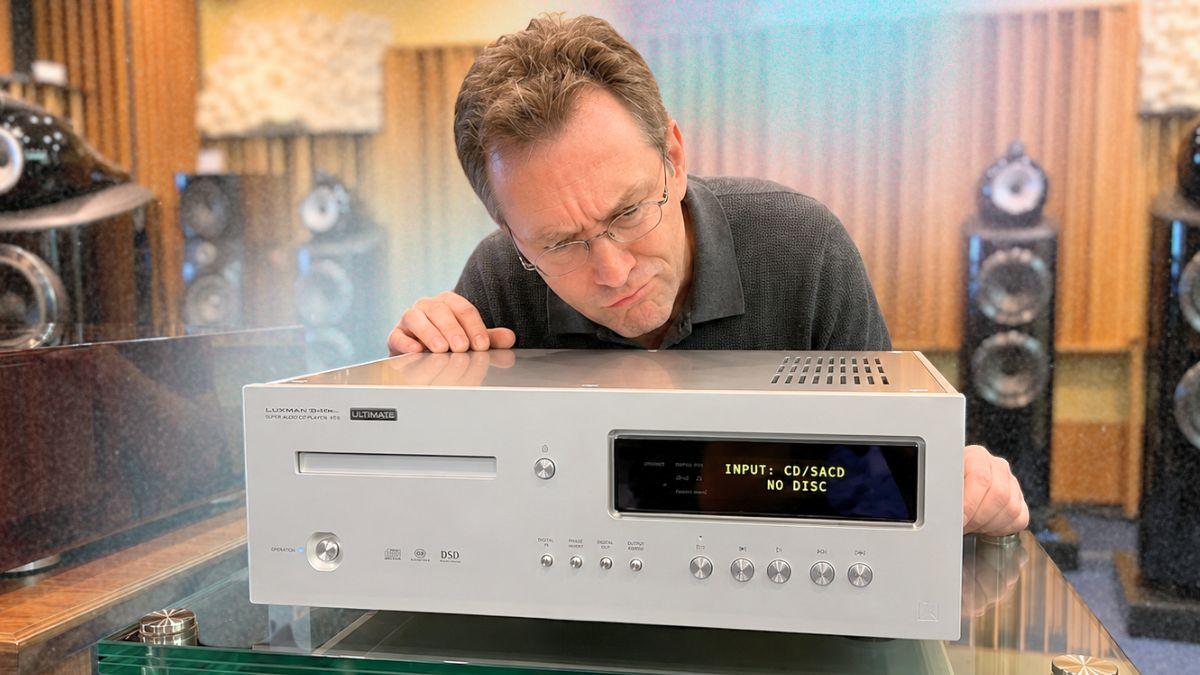
Most listeners have heard the issue for decades without realizing what their player was doing.
Luxman bet its centennial flagship on a problem most listeners have never heard of.
The $18,995 D-100 Centennial redesigns the CD transport mechanism, wrapping a proprietary disc reader called LxDTM-i in machined aluminum and steel. It must keep a laser locked onto data pits just 1.2 micrometers wide while the disc spins at up to 500 rpm.
A human hair is roughly sixty times wider than each pit, which explains why Luxman treats mechanical stability as the D-100’s central engineering problem.
Six Years for a Disc Reader
For its 100th anniversary, Luxman chose to make the D-100’s transport the centerpiece rather than treating it as a commodity part. The company says the LxDTM-i took six years to develop, and nearly every major mechanical choice in the player is built around keeping that disc reader stable.

The LxDTM-i sits inside 8mm-thick aluminum side frames, a 5mm steel top plate, and an 8mm aluminum base, all bolted directly to the main chassis rather than floating on isolating mounts. The brand also positioned the transport on the left side, which it says creates the shortest possible signal path to the dual-mono ROHM BD34302EKV DACs.
Luxman focuses heavily on the transport because a CD player’s job is mechanical before it is digital.
The laser has to stay locked onto a microscopic spiral track while the disc changes speed beneath it, and the audible question is not whether the player can read most of the data. It is what happens when tracking errors become serious enough that correction gives way to concealment.
What happens when the laser slips
A CD spins between 500 and 200 rpm depending on track position, slowing as the laser moves outward. Sound on Sound Technical Editor Hugh Robjohns compares the tracking precision this demands to “flying a jumbo jet at three million miles an hour, while keeping the nose wheel aligned to within about 20cm.”
When the tracking holds, error correction handles the rest. “CD employs dual layer Reed-Solomon error correction…data is reconstructed perfectly, completely without error,” writes Head-Fi user Gregorio, and the digital stream leaving the player is identical to the original master.

But when it doesn’t hold, the system falls back on concealment.
Once concealment fills in corrupted samples with interpolated guesses, no external DAC can recover the original signal because the damage happens before the data leaves the player.
Luxman’s bet is that heavier, more rigid hardware keeps the laser tracking accurately enough that concealment never triggers on an undamaged disc.
The Club Luxman Just Joined
Luxman is stepping into a small, expensive corner of hi-fi where the disc transport is not treated as a background part. For these manufacturers, the mechanism that holds, spins, and reads the disc has become part of the product’s identity.
The longest-running example is Esoteric’s VRDS-ATLAS system, refined over more than 30 years and built around a full-diameter metal platter that clamps the disc during playback.
Its proprietary ceramic bearings were co-developed with NSK Ltd., and the mechanism alone weighs 6.6 kg.
That history also gives Esoteric a much longer transport record than Luxman, whose LxDTM lineage traces back only to the D-10X era around 2020.
Other rivals have made the same point through different materials and construction choices.
dCS, for instance, machines the Varese transport chassis from single billets of aluminum with constrained-layer damping, while Marantz uses its SACDM-3 mechanism inside a triple-layer aluminum chassis with copper shielding.
It’s easy to see how far this transport-first thinking can go just by looking at the prices:
- Marantz’s SACD 10 sits at $14,000
- Luxman’s $18,995 D-100 lands in the lower half of the group
- dCS reaches roughly $39,950 with the Varese transport
- Esoteric’s Grandioso P1X SE costs $58,000.

Across that $44,000 spread, the engineering is elaborate and the metalwork is serious. The missing piece is evidence. None of these manufacturers has published blind-test proof that transport precision creates an audible improvement.
Three Tests, Same Answer
The pro-transport argument is not that CDs routinely lose whole blocks of music. It is that vibration, servo activity, and signal timing can affect playback before an external DAC ever receives the data.
For Luxman, that claim matters because it turns the D-100’s heavy transport from luxury metalwork into an audible-performance argument. Blind tests, however, have been less supportive.
Archimago’s blind test, for one, asked 101 respondents to compare four digital sources, from a computer motherboard to a Sony SACD player.
About 60% detected no meaningful difference. Apparently, only the motherboard was reliably identified as worse, likely because of audible 60 Hz hum rather than a digital artifact.
But even that result was narrow. Archimago noted that the lone statistically significant finding only showed the odds were slightly uneven across a large number of trials, not that listeners were reliably spotting transport differences.
Harley Lovegrove, on the other hand, narrowed the question by feeding seven CD players, spanning 1989 to 2023, through a common external DAC via coaxial output.
Three trained listeners evaluated each under single-blind conditions, and a $49 Philips sounded practically indistinguishable from models costing over $5,000.
The most striking result, however, involved an engineer who claimed unmistakable differences in casual listening but refused formal blind testing.
When a forum member level-matched and ABX tested the same recordings, he scored 7/16 and 8/16, consistent with random chance.

What these results mean exactly
The tests do not prove every CD transport under every condition sounds identical. Damaged discs, faulty mechanisms, noisy outputs, poor grounding, or a player with audible hum can still create real problems.
But they do leave Luxman with a narrower claim to defend: on an undamaged disc played through a properly functioning transport, blind comparisons have not shown that a costly mechanism reliably beats a cheaper competent one.
That conclusion lines up with the stricter “bits are bits” side of the debate.
Price complicates the opposite argument too. In one Head-Fi discussion, one user who argued that transport quality can matter still found a $600 CD player matching a $3,000 DVD player. So even among listeners open to transport differences, cost alone was not a reliable guide.
This means, while the debate is not technically closed, the experimental record so far runs one direction, and Luxman’s case for the D-100 may ultimately rest on something other than what listeners can prove they hear.
Who’s Buying a $19,000 CD Player in 2026
If blind tests have not clearly shown that expensive transports sound better, the D-100 has to make sense in another way. Its strongest case may be cultural and commercial rather than purely sonic: Luxman is building a statement CD player at a time when the format is shrinking in the West but remains unusually important in Japan.
In the United States, the market is moving the other way. The RIAA reported 29.5 million CD units sold in 2025, an 11.6% decline from the prior year.
Vinyl surpassed $1 billion in US sales that same year with 46.8 million units, generating more than three times the revenue of CDs.
Among audiophiles, the D-100’s SACD support narrows the audience even further.
A Darko Audio poll of 10,000 respondents found that 83% own zero SACDs, meaning the high-resolution disc format the D-100 supports barely has a library to draw from for most listeners.
But Japan changes the picture, as AMW Group estimates that 58.3 million CDs were sold there in 2025, accounting for 56% of worldwide CD sales and generating roughly $547 million in revenue.
That is roughly double the U.S. volume from a nation with a fraction of the population, making Japan the clearer market context for the D-100.
Luxman’s transport engineering may not be audibly unique in a way blind tests have proven, but the company is not only selling proof. It is selling a centennial object for one of the few major music markets where compact discs still matter.