
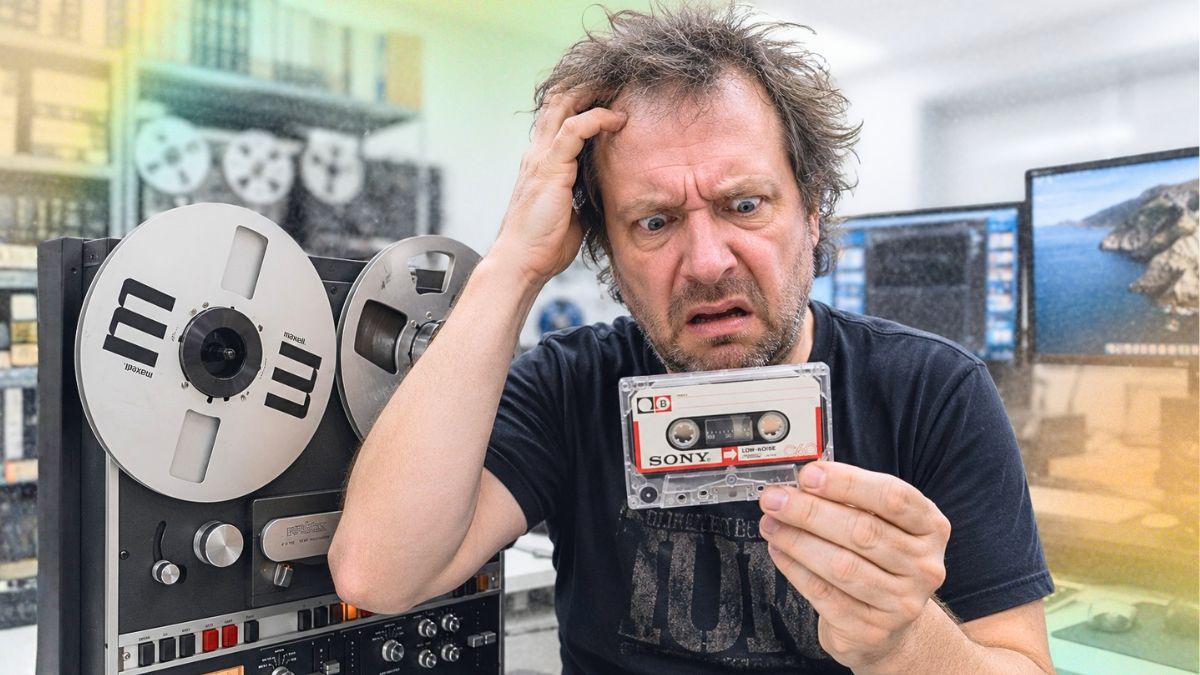
The math that drove their decision flips everything assumed about modern versus outdated storage.
For years, music archivists raced to rescue old analog reels before the recordings on them broke down. Digitizing those tapes solved one problem, then created another: where should the new files live for the long haul?
As it turns out, many archivists still keep a copy on modern data tape, such as LTO, because cloud storage alone has too many open questions. That’s because cost, access, company survival, and data checks all matter when the goal is keeping music safe for decades.
This same problem now reaches personal libraries, too. Streaming playlists, cloud lockers, and backups can disappear faster than people expect.
Here is why the people paid to preserve music still trust shelves.
A Phone Call and a FedEx Box
When Grateful Dead archivist David Lemieux needs a recording from October 18, 1972, he doesn’t search a database. He picks up the phone.
The “Jeffrey” is engineer Jeffrey Norman, who inspects each tape’s physical condition before production begins.
What arrives at his door is a reel that sat in storage for decades and still holds a playable performance. The collection covers 422 live shows spanning 30 years, 20 of which had never been released.
But transferring all of it required pulling tapes from vault storage, digitizing at maximum resolution, and running full studio mastering sessions on recordings that never received that treatment when they were first captured. Brad Serling, nugs.net’s founder, had a name for it.
“(It’s) the largest tape transfer project in the history of rock ‘n roll,” described Brad Serling, nugs.net’s founder.
Serling wasn’t exaggerating the stakes either. It’s a fitting description for tapes that had captured the band in the room night after night and now had to be handled as both historical documents and production masters.
They survived because they were physical objects sitting on shelves, immune to server migrations, licensing disputes, and the business decisions of companies that didn’t exist when the recordings were made.
Three Failures No One Fixed
The Grateful Dead archive shows what physical preservation can do for music history. But once recordings become digital files, archivists still have to decide where those files can survive for decades.
At the international digital preservation conference’s November workshop, archivists presented three unresolved trust failures with cloud storage:
- They could not confirm that copies stored in different cloud regions were genuinely independent.
- They could not verify data integrity without relying on the vendor’s own tools.
- They could not predict what it would cost to leave, because egress pricing was “a maze” with “calculators that feel neither intuitive nor comparable.” And this cost visibility was flagged as a universal challenge.
That last failure is measurable. Digital preservation researcher David Rosenthal found in 2019 that pulling one petabyte out of Amazon Glacier costs 13.8 months’ worth of storage fees in retrieval charges.
And for institutions that need to verify their holdings periodically by downloading and checksumming files, those exit fees compound with every integrity pass.[
Then there’s the question of whether the data actually survives. Cloud providers market “11 nines” (99.999999999%) of durability, a number designed to sound like a guarantee.
Those calculations exclude human error, viruses, software bugs, and malicious employees, which Rosenthal found account for approximately two-thirds of real-world data loss. Archivists have spent decades learning how collections die, and what they warned about is already happening.
Fifty Million Songs, Gone
MySpace proved the archivists right first. In 2019, the platform confirmed that content uploaded between 2003 and 2015 “may no longer be accessible.” Technologist Andy Baio estimated that approximately 50 million songs from 14 million artists disappeared in a server migration, with no offline backup to recover from.
Google followed with something more deliberate. Google Play Music shut down in December 2020, and by February 2021 all remaining user data was permanently deleted. Users who failed to export in time lost their libraries not through negligence or accident, but through a scheduled corporate decision.
Then there was Ultraviolet. The cloud-based media locker, backed by major Hollywood studios, shut down in July 2019 after more than 30 million users had stored over 300 million movies and TV shows. The service simply ceased to exist.
For everyday listeners, these failures matter because personal libraries now depend on the same basic assumption: someone else will keep the files available. A playlist, upload locker, or purchased-media library can feel permanent right up until a migration fails, a deadline passes, or a service decides the archive is no longer worth maintaining.
These weren’t obscure platforms running on shoestring budgets. They were backed by some of the largest technology and entertainment companies on earth, and they still disappeared.
However, this payment buys access, not a guarantee that the data survives. Archivists saw this structural flaw decades ago, and the technology they chose as an alternative is still advancing.
Forty Terabytes, No Subscription
Archivists didn’t settle for the tape technology they inherited. They kept building on it. In January 2026, Fujifilm began shipping LTO-10 cartridges with 40TB of native capacity and up to 100TB compressed, 2.2 times the storage of the previous generation. LTO tape shipments reached 152.9 exabytes of total compressed capacity in 2023, meaning the format is growing, not winding down.
Cost makes the argument concrete. An LTO-9 cartridge stores 18TB for roughly $85, which works out to about $4.72 per terabyte as a one-time purchase. Cloud archive storage starts at $0.99 per terabyte per month. That monthly bill never stops, meaning the cloud’s apparent affordability erodes over time while the tape cartridge sits on a shelf, fully paid for.
Once ejected, an LTO cartridge is physically disconnected from every network, so ransomware, outages, and provider policy changes cannot reach it, so the shelf is the point. For instance, Fujifilm marketed LTO-10 explicitly as air-gapped protection against hacking and ransomware, because that’s where institutional demand is pointing.
Professionals aren’t abandoning cloud, though. But the question has moved past choosing sides.
Cloud handles access, while modern data tape handles survival. For personal music libraries, that distinction barely exists.
Your Library’s Expiration Date
Archivists work on century timelines, but the companies selling you cloud storage do not. In the 1920s, S&P 500 companies lasted an average of 67 years, a figure which has since collapsed to 15 years according to Yale professor Richard Foster’s research cited in Harvard’s analysis. Amazon Web Services launched in 2006, meaning it is 20 years old.
Jeff Bezos himself has acknowledged the math.
To be fair, he was speaking generally about companies, not making a specific prediction about AWS. But the implication lands. If the founder of the world’s largest cloud provider doesn’t expect his own company to last a century, the infrastructure built on it carries an expiration date that no service-level agreement addresses.
Your music library sits inside that structure. Streaming services revoke access when licenses expire, while cloud lockers charge to leave and delete files when payments stop. A single hard drive fails without warning.
For personal collections, that means keeping local copies, exporting libraries when possible, and treating cloud access as convenience rather than permanence.
Tapes from the Grateful Dead vault have survived since the 1960s, while AWS has been around since 2006. The tapes are winning on track record alone.
“Boring human neglect kills archives” more reliably than any technical failure, Harvard’s Library Innovation Lab found.
The danger was never a spectacular cloud collapse. It was always everyone quietly forgetting to care.